
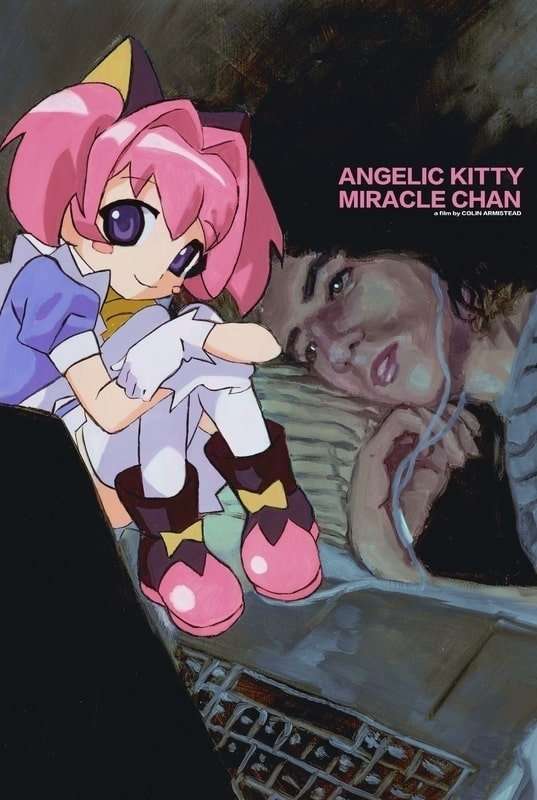
Angelic Kitty Miracle-chan is a short film by animator Colin Armistead, that touches upon the relations between anime culture and gender dysphoria. I first heard of this video via Twitter among a firestorm of controversy from multiple sides. On one side, I saw angry right wing chuds who called it an attack on anime culture, and I saw wokescolds referring to it as borderline transphobic in its portrayal. After having seen the film for myself, I can safely say that both of these groups are insipid morons.
I’m so sick of media discourse being driven by people who either have the media literacy of a toddler, or who are outright propagandists who think art’s only use is for how to promote a political message. There’s no quicker way to hate humanity than to pay attention to this insufferable trend in media discourse of people being completely and utterly wrong about everything, and doing so really loudly and aggressively.
What better backdrop for me to finally get back to writing regular media content that isn’t just two reviews to buffer between a long rant piece about some sex criminal who has inexplicably escaped prison time? I’m sure that new readers will be confused by everything I said here, but this is going to be a fairly personal analysis, as it deals with subjects that are quite personal to me as both a trans woman, and an anime fan.
The video opens with what appears to be the opening to a Magical Girl anime. Right away, one can see that the animation is fantastic and can easily be mistaken for something from a professional studio. This animation is also very true to the style of magical girl anime, and nails the vibe perfectly. If you showed this to someone out of context, they’d assume it’s it’s from some obscure anime and not a short experimental film. That being said, there is one uncommon element of this opening, that being that it appears to depict a young boy transforming into a magical girl.

While there have been some magical girl anime to include trans characters, the only two I can think of are Mahou Shoujo Site and Magical Girl Raising Project, both of which are among the edgier Madoka inspired takes on the genre, and whose portrayals are far from hopeful or innocent like Angelic Kitty. I’d also like to talk about the lyrics to the theme song.
If we collect the fragments of happiness
see, it’s just like a miracle.
The power is already in your heart!
life isn’t always so simple.
but I can show you how to make your dreams come true.
At first, one may think that this is typical children’s show fair, but you’ll notice that these lyrics almost seem to be speaking to the listener. Now, this is also fairly typical of children’s animation theme songs, but it will take on a completely different tone later on.
By now, you can also see that our young boymoder has their walls adorned with posters of the titular magical girl. Note that it’s uncommon for people to have a bunch of posters of themselves in their own room, and SPOILER ALERT, this kid transforms into the magical girl. It’s almost as if a Magical Girl is treated as a state of ascension, or something granted. And again, the ability to transform into a magical girl is usually granted to young girls in their respective shows, but you can see that a double meaning is being set up.
There are times when you just can’t reach
C’mon hold me tight, hand in hand. Let’s Fly!
Even on sad days I will meet you with a smile.
After all, I want to be your light
and also
This set of lyrics seem to be speaking to the notion that someone can’t attain something on their own, the following lines emphasizing the desire to be a guiding light, and to help the subject “fly,” a word both hinting at escaping bounds or restrictions, and also allowing one to gain height, tying into the earlier line of “reaching” something. What needs to be noted is that this set of lyrics are more personal and intimate than the first few. This goes beyond simple inspirational speak and to outright desire to reach others on a personal level. This is coupled with the boymoder’s transformation sequence.
In a detail that I will be surprised if any other analysis addressed, the most emotionally charged lyric “Even on sad days, I will meet you with a smile” plays during a shot of this very young character’s underwear, even complete with a brief upskirt shot. This is very true and accurate to a lot of magical girl anime anime aimed at young girls that will have an odd hint of sexuality to them to appeal to a periphery demographic of adult fans.
I am going to assume that this was the part that lead some to deem it as transphobic, possibly because they interpreted this sequence as the creator’s perversion rather than simply an accurate replica of the genre it depicts. But at the same time, it is not critiquing this aspect anime culture, more so than subtly reminding the viewer that it exists, for a reason that will become apparent later on. Lastly, you get a glimpse of the villain character of this series… note how they look rather androgynous, more foreshadowing.
Transform with the power that all girls hold
That Power is already within you
The fact that you’re beside me
that alone is a miracle
Come on the time has come.
As the final verse completes, the camera zooms out on our real life boymoder, named Alex, who is reading an online tutorial about shaving her legs for the first time while watching this opening on loop. The camera showcases the boymoders room adorned with anime posters and memorabilia, most of them based on the in universe Angelic Kitty Miracle-chan. The saccharine Angelic Kitty theme song contrasts the image of the boymoder’s hairy legs, complete with a shaving cut. This shot instantly captures internal contradiction of gender dysphoria, where one’s own body clashes with their internal desires. Alex wishes to be cute, beautiful, and free like Miracle-chan, but is instead in a dreary white room, with hairy legs. In a few short seconds, the appeal of Magical Girl anime to so many trans people is made clear.
The next scene has Alex sitting in class, scrolling through her phone during, where one can briefly see a few memes about Angelic Kitty Miracle-chan. One of the memes is literally about doing Meth. I find the inclusion of this meme to be interesting because it’s the exact type of meme you’d expect to see in places like shedtwt. The next meme you see is literally a trans meme. This paints a picture of traumatized, often queer teenage girls, both cis and trans, that gravitate towards bright, colorful, and saccharine anime like Angelic Kitty Miracle-chan. This is in contrast to the usual stereotypes about adult fans of children’s anime being middle aged pedophilic males.


After class is over, Alex is approached by her friend, named Anna, who asks her to come hang out, to which the boymoder declines. Based on Alex’s flimsy excuses, only managing to come up with “stuff” and “homework,” it is made clear that she is socially isolating herself due to depression induced by gender dysphoria. Social withdrawal is common for closeted trans people. The very nature of our existence requires constant masking. I can speak from my own experience that, when I was closeted, if I was honest about my feelings, every conversion would be “life doesn’t feel like it’s worth living if I can’t be a girl and I’m stuck in a state of unimaginable hell on earth until I can be.”
Anna also leaves a quip about how “jerking off in your room all day” doesn’t count as plans. This quip references a common stigma against both trans people and anime culture. Both are often dismissed as perverted, albeit for different reasons. The idea of trans women being perverts is mostly pushed by deranged right wing freaks. It is a belief that is becoming more and more fringe as time goes on, but many trans people still internalize it on some level. Additionally, there are many trans people who may discover their transness through kink, and who convince themselves that it’s all there is to it.
That being said, the major focus is on the anime shit. I’m sure I don’t need to remind people that anime is often stigmatized as perverted fetish slop, especially anything with cute girls. And adult fans of magical girl series, especially adult male fans, they’re basically seen as pedophiles. So imagine the shame carried by a young, deeply closeted trans woman, a member of an already stigmatized minority group, carrying interests that are looked down upon even by other trans people.
When I was closeted, I carried this belief that I was nothing more than vile imitation of something beautiful. That femininity was something unreachable, and that choosing to identify myself with it was an insult to women everywhere. I’ve felt robbed of my childhood, because I grew up as a socially withdrawn male who didn’t have female friends. One yearns for things that, in all honesty, aren’t even good for cis women, like getting pregnant or periods. I’ve often described gender dysphoria as “feeling like you’ve never showered or bathed in your entire life.” You feel disgusting, hideous, and horrifying, and thus, gravitate to what you want to be. But your vision for yourself is unachievable, because even if you transition, you can’t go back.
It’s honestly quite amazing how being robbed of one’s childhood is basically a right of passage for most trans women, yet when we transition, we are judged for displaying childish qualities in adulthood? Early on in my transition, I tried out a specific, light pink shade of makeup, and my older sister told me not to use it because it looked childish. With the element of hindsight, she probably didn’t even intend any offense, and just viewed it as advice on how to abide social norms. But I transitioned so I could escape social norms, not to squeeze myself into another box. And the notion that you have to be a “normal woman” when you transition has kept so many trans women in the closet. I should know, it kept me from realizing it in my teenage years, because I believed that “real women” weren’t degenerate anime tiddy loving perverts like me.
The next scene is Alex walking home, while listening to the Angelic Kitty theme on repeat, because it was not made clear to us that she really likes Angelic Kitty Miracle Chan. She picks up a package, enters her room, and we can see her wall is adorned with magical girl posters, most of them of Miracle Chan. One can also see that one of those posters is Miracle-chan on her knees with her back arched. Once again, there’s a tiny hint of sexuality to it, leaving it open to interpretation whether the boymoder’s fixation on Miracle-chan is purely admiration or if it’s sexual.

That’s what I find so compelling about this short film, it isn’t some liberal inspiration porn of the most clean and normie friendly portrayal of a trans woman, there’s an acknowledgement that trans existence is sometimes messy and bad for optics. But at the same time, there’s only a small hint of messiness, allowing this short to connect with trans people whose existence may not be friendly for rainbow capitalism, while also not going too far in its portrayal as to imply trans people are dysfunctional perverts. The small bit of messiness exists to reaffirm why shame and repression may exist in trans people to begin with. And while it doesn’t outright defend trans people that may be dysfunctional perverts, it also doesn’t take a stance against them, which is noteworthy considering the recent trend of toxic puritanism.
The next scene has Alex opening a package, which contains a cosplay outfit of Miracle Chan, complete with a mask that covers her entire head. The boymoder closes the curtains and dims the life, undresses, and changes into the outfit. We see while she’s changing that she’s unable to zip the dress up all the way, and that the sleeves don’t go all the way up. This is a painful experience that many trans people have endured, the realization that women’s clothing is designed differently and is often too small for us. I personally experienced something similar when I first came out, and it was devastating. My money was wasted on a cosplay maid uniform that didn’t fit, and it made me feel ugly, freakish, and dysphoric. This exact same sensation is represented as our boymoder puts on her mask, despite the dress not fitting, because she wants to salvage anything she can.
She gets a text message from Anna, which startles her, and immediately afterwards, she’s jump scared by her projector, which plays the Miracle-chan opening, blasting the music at her and shining a light on her, contrasting her image with the anime character she so desires to be like. This source of comfort is now a source of horror, and is viewed as an impossible goal that she feels they can never live up to. The way this projector immediately acts up is almost supernatural, as if she’s being haunted by her own unachievable dreams. And notice how this occurs right as she got her text from Anna. Right as real life collides with Alex, it causes all of her to immediately come pouring out.

However, one will notice certain details that contradict the notion that Alex’s dreams are unattainable. The most obvious of these is that her dress isn’t THAT small. She probably could have zipped that up all the way if she had someone else help her, but she didn’t trust anyone enough to tell them about this. I also want to draw attention to the fact that Alex has mostly female friends. The two friends that Anna mentions are Mabel and Sonia, both of which are girl’s names. Given that Alex is already meek and rather feminine in her demeanor, Anna probably wouldn’t be too surprised if she found out Alex was trans. Hell she might already know.
And that is the ironic thing about this short film, it would be a lot easier for Alex to transition that a lot of trans girls. She already has this very short and skinny build, while there are plenty of trans women that are over six feet tall, or that are fat. And this is only discussing body type. There are numerous other factors that are not even mentioned in this video, such as background, whether one lives in a conservative family, medical issues, race, income, disability, past or ongoing trauma, mental illness. But I can tell you straight up, none of those have stopped people from transitioning. Yet, the next scene has Alex throwing away her cosplay outfit, and the film ends on her choosing to retreat back into social isolation, comforting herself with the Miracle-chan theme song.

Angelic-Kitty Miracle-chan is an interesting film, but what’s more interesting is how people’s reactions to it seem to speak to their own beliefs. After I wrote most of this, I looked up a few of the analysis videos about it. There was one that portrayed Alex’s fixation as this delusional coping mechanism by someone who wanted to escape from reality by effortlessly turning into an anime girl. This pessimistic view is revealing because it shows that they didn’t notice the fact that Alex could have fit in the costume if someone else just zipped it up for her. Rather than viewing this as the first step in a long process, some seem to have interpreted this film as affirming their worst fears about transitioning, and their response is to either dismiss it as transphobic, or accept it as affirming their hopelessness. And the thing is, I didn’t notice that observation about the zipper either, and not until I was already most of the way through this script. And yet, my interpretation would have likely been the same if I didn’t.
After all, it’s not like I gave up when my outfit didn’t fit, and that one actually was too small for me. I came out in 2015, when trans rights were far less widespread. And there were people before me who still came out, even during times where that meant leaving behind your friends and family. People transitioned during time periods where there was no access to hrt or surgery. So why in the name should anyone stop them because it’s difficult? You think Miracle-Chan was always able to effortlessly transform?
Anyway, I specifically make a point of not taking the creator’s words into account in analysis pieces for this reason. Because if Colin Armistead is against this interpretation, then I don’t want to hear it. That being said, from the brief look I took at Colin’s Twitter, they don’t seem like the type that would intend some sort of gatekeepy message like that.
What I ultimately choose to view Angelic Kitty Miracle-chan about is the acknowledgement of hardship, but the refusal to give up and assimilate, whether it’s in being trans, or in liking girly Magical Girl shows for kids despite being an adult. After all, Alex goes right back to watching Miracle-chan right after she was traumatized by it. That doesn’t look like quitting. I also view it as representative of how fiction can inspire so much more in us than just entertainment, even if it’s never intended as some extravagant, complex masterpiece. And finally, I choose to view it as a declaration that you to, can transform with the power that all girls hold, because that Power is already within you. And the fact that you’re hear beside me, that alone is the greatest miracle of all.

–
If you would like to support me or this site, then please pledge to my Fanbox or make a donation to my Cashapp ($AnniegaIIa) or Venmo if you would like to see higher quality content with more resources to put towards it. If you don’t want to spend any money on me, then you can also help by sharing my blog on Facebook, Twitter, Tumblr, Reddit, or anywhere else where others will see it. You can also follow this blog if you would like to be kept up to date on my stuff.
this was really beautiful, thank you for writing this. you really got the message that twitter users didn’t. (honestly that website should be dead by now, it’s horrible there.) miracle-chan is a really special short film that captured a lot of specific feelings for me as an autistic woman who also has a girly pink anime special interest, and this kind of loving & optimistic reading of it made me happy. it may not be possible to become miracle-chan specifically, but it’s always possible to be a cute pink girl, and you always deserve to live as one :3