
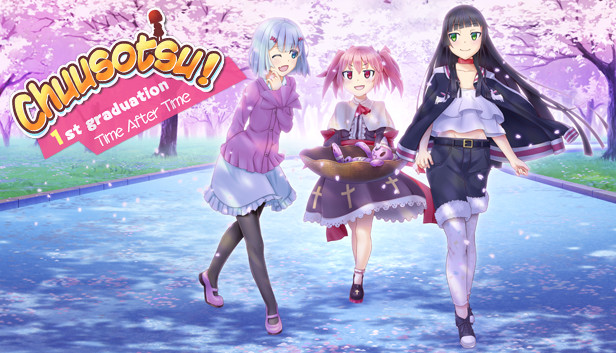
At time of writing, I’m in a pretty dark place emotionally. I don’t want to open a review by trauma dumping, but I’ll just say that I’m experiencing a lot of fear, uncertainty, and vulnerability. I mention this because Chuusotsu was one of THOSE games, the ones that feel like they were made specifically to speak to me. It’s also fitting since it was requested by a patron. Yes, I know, I took too long to get to this, it’s why I don’t offer review requests as rewards anymore, I’m terrible at getting these out in a timely manner.
Chuusotsu comes to us from Studio Beast, whose only other release is Chuusotsu! 1.5th Graduation: The Moving Castle. Considering that it’s been 5 years since its release, it seems like plans to make this into a series has fallen through. It’s quite unfortunate, as Chuusotsu has a wonderfully endearing cast and an emotional and heartfelt story that isn’t afraid to touch on some dark, philosophical subjects.
Chuusotsu takes place in a world run by P3 law, where citizens are ranked according to the authorization seals issued by the world government. These seals determine one’s career path, and their direction in life, and they are assigned based on the results of an exam one takes in middle school. At first, this simply sounds like it’s based off of similar policies in communist countries like the former Soviet Union. However, those in Chuusotsu are even more restrictive, given that the seals also provide people with boosts to their physical and mental capabilities. This, in turn, means that those without seals gradually decline in physical capabilities and in intellect.
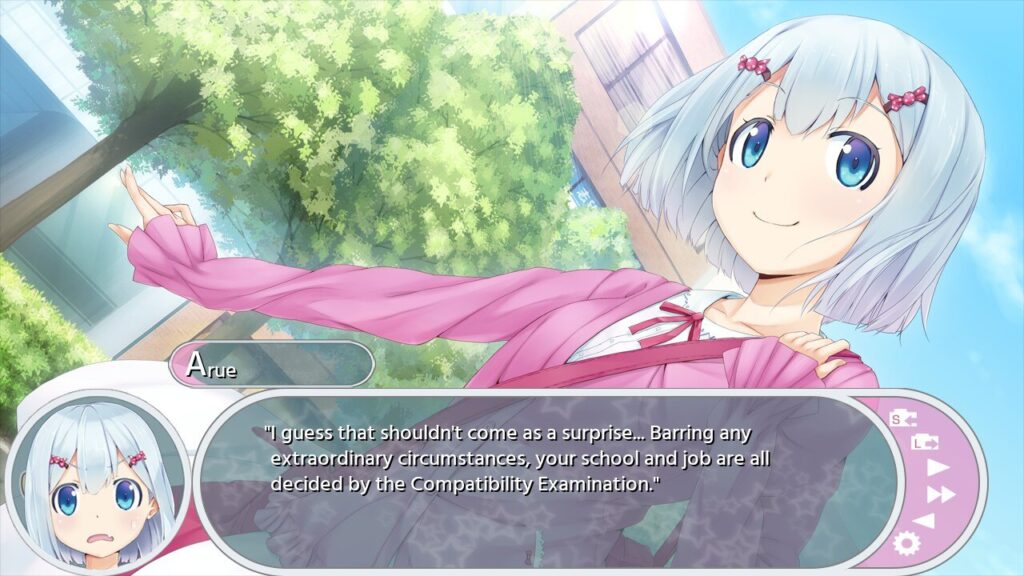
The game’s title “Chuusotsu” is named after the word for those who fail their exam and who have no seal. This game also stars three Chuusotsu, Arue, Koiro, and Arara, though most of the game centers around Arue. These three characters all have a wonderful dynamic, and I found myself getting attached to them and their antics. Arue is one of those rare examples of a character that I connect with on such a level that I see myself reflected in her, and both Koiro and Arara are so endearing and fun. The characters are one of Chuusotsu’s strongest points in just how attached to them one can get. After just one game, I feel like I’ve known these three my entire life.
The strength of these characters supplements the core theme regarding the dehumanization and subjugation of those lowest on society’s ladder. The outcasts, misfits, and NEETs, who are dismissed as parasites dragging society down with their existence. There is this frequent contrast between the characters that you want to see succeed in life, and the in universe perception of them, which is not far off from how our own culture operates. Chuusotsu, however, does not take the easy route of portraying our main cast as without vice, but rather, paints them as flawed people who do possess many of the traits they are stereotyped as having, but who are also so much more than them.
There’s a common mistake in media with progressive messaging where it’s believed that you need to subvert stereotypes at every turn, and create the cleanest possible portrayal of a marginalized group. This often results in vapid inspiration porn that’s intended more for the sake of a straight, white, cisgender, heterosexual, and neurotypical audience than the communities they represent. As a result, there’s the expectation that marginalized communities represent not only themselves, but also their entire people, and that those who exhibit certain flaws are a “liability” that should be excluded from their community for the sake of larger acceptance by society at large.
At first, it appears that Arue’s character is supposed to be an example of this trope. Of someone who is hardworking and determined, but who fails her examination because she got sick, and now the rest of the world assumes she only failed because she’s lazy and incompetent. Saying that “stereotypes are wrong” and leaving it at that is not smart writing. While it’s true that there are bigoted and shallow people who choose to view marginalized communities through a shallow lens, these people will often have a long list of individual examples that they’ve seen or heard that vindicate that reinforce that view.
What IS smart writing, however, is to deconstruct the very idea of certain stereotypes as a whole, and what leads people to embody that one. While Chuusotsu’s setting is obviously reminiscent of that of communist countries, the notion of certain people being drains on society and choosing to leech off of government money or donations is a very capitalistic ideal. In fact, it’s likely that a communist setting was chosen because one of the most common fears of left wing government is the idea that hard work does not determine one’s success, and that the lazy welfare queens will waste everyone’s tax dollars.
The conflict of this story is that our main trio are part of a government program where chuusotsu are given a home with each other, and must complete a challenge in order to keep their new home. The goal of this challenge is for the three of them to synchronize their minds and answer the question “what makes a wonderful life?” They also have only a week to do so, but they have plot armor so they have more time than that.
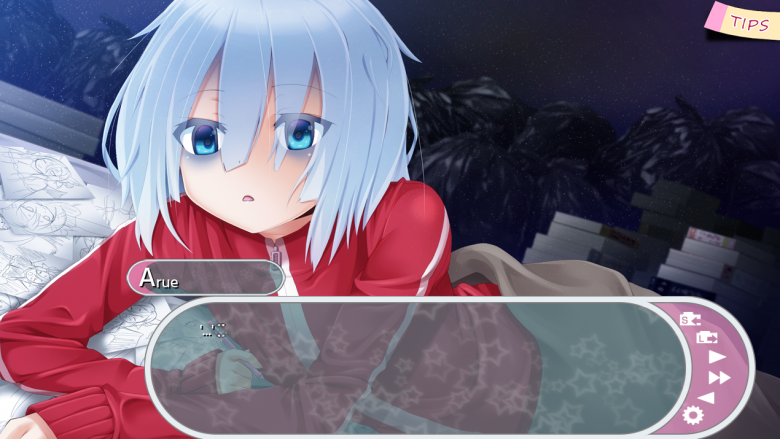
While most of the game is fairly light hearted, and occasionally emotionally intense, the final chapter takes an especially dark turn. While I do not want to spoil what happened, I will say that it involves cyberstalking, kidnapping, attempted murder, and child prostitution. While this is a highly unexpected shift in tone, it works precisely because it delves into the darkest implications brought about by P3 law.
I also have to give credit for the fact that this game’s climax felt like it was made to address me specifically. The parallels between myself and the game’s main character are quite obvious. I’m a severe agoraphobe who is terrified at the prospect of working a “normal” job, instead of following my dreams. And this is further compounded by the fact that Guardian Acorn… isn’t exactly a lucrative career. For comparison, Arue’s central conflict is contrasting her supposed desire to become a government worker, something that she only wants because society tells her she should and because it would financially support her family, and her actual dream of becoming a mangaka, which society would look down upon.
For most of the story, Arue suppresses her dream to be a mangaka, and repeatedly answers that “a wonderful life” is having a well paying job and being a productive member of society. This is until the end, where Arue starts to abandon any of her studies in favor of escapism, repeatedly utilizing time loops so she can keep spending time with her friends… it makes sense in context…
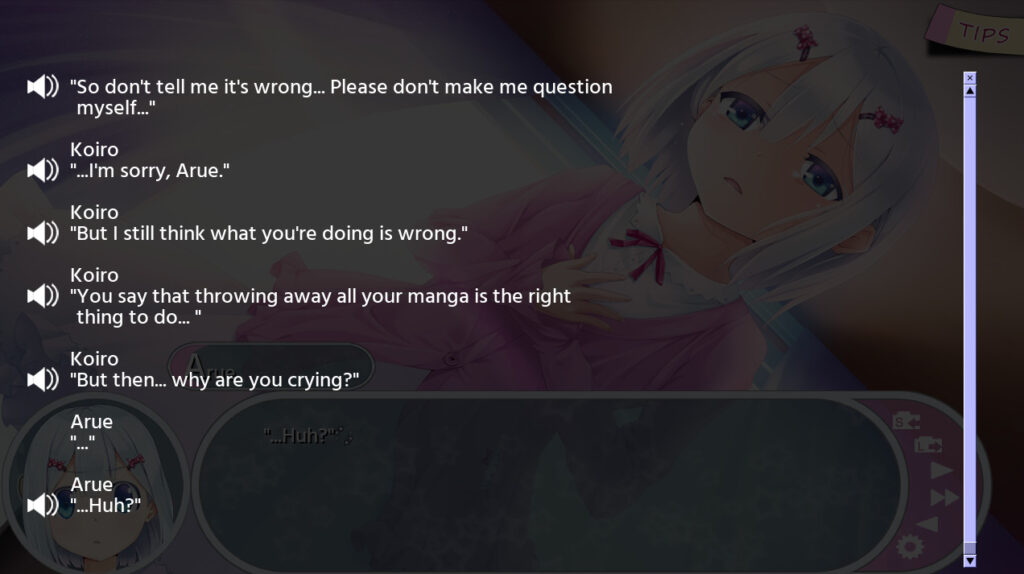
Rather than dismissing the problem as Arue being “lazy,” Chuusotsu chooses to depict Arue’s troubles as being disconnected from her studies, and makes a point of showcasing how much innovation and effort is put into Arue’s manga, when compared to her studies. This is Karl Marx’s theory of alienation in action; Arue struggles to fixate on her studies because she only ever choose to pursue a government job out of obligation, rather than out of genuine desire. This is in contrast to her manga, where she has complete creative control over the means of production.
SPOILER alert for the next paragraph
This culminates in the finale, where Arue is brought to a severe state of depression, believing that Manga has ruined her life due to derailing her from the path of becoming a “productive member of society.” Right as she overcomes her depression, she comes face to face with the main villain of the story, someone who is so kool-aid deep in their fanatical worship of system, that they unironically claim that Arue’s disgust with the concept of “legal child prostitution” is just another example of chuusotsu possessing disdain for the concept of hard work, as opposed to basic human decency.
This creates a contrast that frames Arue, someone who supposedly represents all of the flaws and failings of chuusotsu, as someone infinitely more sane and rational than someone with the cult like worship of the system as a whole. And this is something that is very much true to life, simply compare any normal person to the people in the top echelons of finance or government for proof.
Spoilers Over

Chuusotsu called my ass out in a way that I haven’t experienced since I played Omori. The voice acting, music, and illustrations are all solid, but also fairly unremarkable. It really is the writing and characters that carries this visual novel for me, and I can’t emphasize enough that this visual novel really is something special.
I feel bad that I took so long to get to this game after realizing it was THIS impactful, but I’m also glad i got the chance to read it to begin with. There really isn’t much to say other than that it’s sad this series didn’t take off, because we really need more stuff like this.
–
If you would like to support me or this site, then please pledge to my Fanbox or make a donation to my Cashapp ($AnniegaIIa) or Venmo if you would like to see higher quality content with more resources to put towards it. If you don’t want to spend any money on me, then you can also help by sharing my blog on Facebook, Twitter, Tumblr, Reddit, or anywhere else where others will see it. You can also follow this blog if you would like to be kept up to date on my stuff.